The best online fitness resource you'll ever need. We filter out the BS to ensure you meet your health and fitness goals!
The best online fitness resource you'll ever need. We filter out the BS to ensure you meet your health and fitness goals!
We all want broader shoulders, deeper chest, bigger arms, stronger legs. So, we perform our pull ups, our presses, our squats and deadlifts. So far, so good- this is all fantastic stuff to be doing. We want washboard abs, so we perform our crunches, roll outs and leg raises, we hit our obliques and we even pay attention to our deep, transverse abdominis. We maintain caloric deficits so that all of this hard work shows.
Again, all good. This will result in a strong, healthy physique that bears the aesthetic qualities you may be after.
However, there some subtleties to a truly rounded physique- aesthetically, structurally and with reference to strength and performance- that also deserve some attention.
The improvement of scapula function is one such subtlety.
It’s likely one you’ve never really thought of. Well, we’re about to change that, aren’t we?
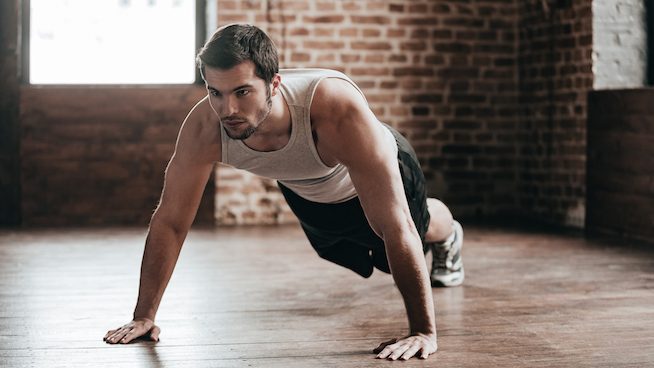
It is something of a major mistake to overlook your scapulae, the rear part of your shoulder blades, when scheduling you’re training. We can overcome this mistake easily enough by simply including scapula push ups- see below. These will strengthen and build the muscle mass surrounding your scapulae.
This is more important than it may sound at first.
The serratus anterior specific is the muscle that you strengthen when you perform scapula push ups. The serratus anterior connects between the ribs, underneath the scapula itself. Its main function is to keep your shoulder blades pressed tightly against your upper back.
In strengthening your serratus anterior, you will be promoting normal, healthy scapula motion, improve shoulder mobility and improving your ability to pin your shoulders back tightly.
This will have direct carry over to pretty much every upper body movement you perform, and even some lower body movements. For instance, being able to tightly contract your scapulae will enable you to pack your latissimus dorsi back and down, which is fundamental to maintaining good form during the deadlift.
Every time you breath and brace under load and rely on hefty force transference through your torso- whether it’s for an overhead press, a rear loaded squat, a nasty scrum, a sprint on the oars- you will need your scapulae to be tight and strong. When they are positioned properly in this way, with a decent amount of contractile force keeping them in place, your scapulae will have solidity enough to keep your shoulders and upper trunk entirely stable.
When they have freedom of movement and strength to back them up, your scapulae will also have mobility enough to stabilise your shoulder joints through a fuller range of motion and movements. This will allow you to move greater loads, safely, without worrying about any loss of performance or risk of injury.
Scapula push ups are a good fix for weak scapulae. They will build and strengthen the muscle mass of the serratus anterior whilst simultaneously creating better mind muscle connection. This will give you more to play with and more ability to play with it.
Use scapula push ups in the assistance portion of your upper body sessions or add them to dynamic warmups, pumping them full of blood and switching on your mind muscle connection.
Scapula push ups are performed with nothing but bodyweight, though you can use a weighted vest or equivalent as you progress to increase resistance. To perform them:
If this is a little tough, begin with a slightly less demanding variation by performing scapula push ups against a wall. For this variation:
As this variation becomes more manageable, switch to scapula push ups as above, but on your knees. Perform them fully as for the main movement. Get used to them, build up your strength and mind muscle connection, then progress to the full version.