The best online fitness resource you'll ever need. We filter out the BS to ensure you meet your health and fitness goals!
The best online fitness resource you'll ever need. We filter out the BS to ensure you meet your health and fitness goals!
Calisthenics workouts are well known for building strong upper bodies and core sections. If you’ve ever seen anybody perform sets of 20 pull ups and dips, you’ll see why. To get to this point, they will have had to build their upper bodies up so much that their shoulders will be twice their natural width, their upper back and chest will be wide and deep, and their triceps and biceps will have some serious mass and pushing/pushing power. In addition, their core will be rock solid as they deal with the demands of moving their body through space in some quite mechanically unstable positions.
Dips and pull ups form the core of many calisthenic workouts, so it’s no surprise that practitioners are often pretty buff up top.
But what about legs? It’s hard to perform 20 pull ups. It’s pretty easy for even beginners to get to 20 bodyweight squats or lunges. There is little stimulus and, therefore, not much by way of overload or hypertrophy opportunities involved in this kind of workout.
Luckily, there is more to leg training than bodyweight squats and lunges- a lot more. Calisthenics offer a wide range of exercises that can bring a lot of stimulus to the lower body, a wide range of training patterns and programs to help the legs burn out, and great opportunities for progressive overload so that you can keep on growing even as you adapt.
So, let’s get it out there at the beginning: you absolutely can build big, strong legs without weights.
However, there are some particular ways of training, a few caveats, and certain mindsets and techniques that complicate things a little. We’ll go into these today as we show you four of the best exercises for building leg muscle without weight, and how to go about structuring your workouts and training.
Let’s begin with some basics.
We need to be very clear about the following. Simply performing these exercises at random will only get you so far. Honour the following few rules and you will see much better, more rapid results.
Taking weights out is not the same thing as taking resistance or effort out. Without resistance- and linearly progressive resistance- nobody’s growing anything: no adaptation will occur. You need to train consistently, often, and intensely, as you would with any hypertrophy program. There are no secrets, no tips or hacks- building muscle takes hard work.
You want to train to failure fairly often, to near failure almost every session, and to the point at which you get DOMs pretty much weekly. Three sessions per week is not ambitious- your aim should be 2-4, with a rest every couple of months. Volume is vital, especially when training without weights: sets of 12-20 will be the norm, as will 20+ sets per session.
All that hard work comes at a price: fatigue. This fatigue is your friend– in fact, it’s vital for hypertrophy, as your body recovers and repairs itself stronger, with denser muscle tissue. This process of repairing is where your gains come from (not from the training itself). So, give your body time to repair and heal. Get a full night’s sleep of 7-9 hours as often as you can. Take part in light, active recovery for your legs (go for a daily walk, or light jog of cycle). Make sure you get a full 24-hours between training sessions, aiming for 48 where possible.
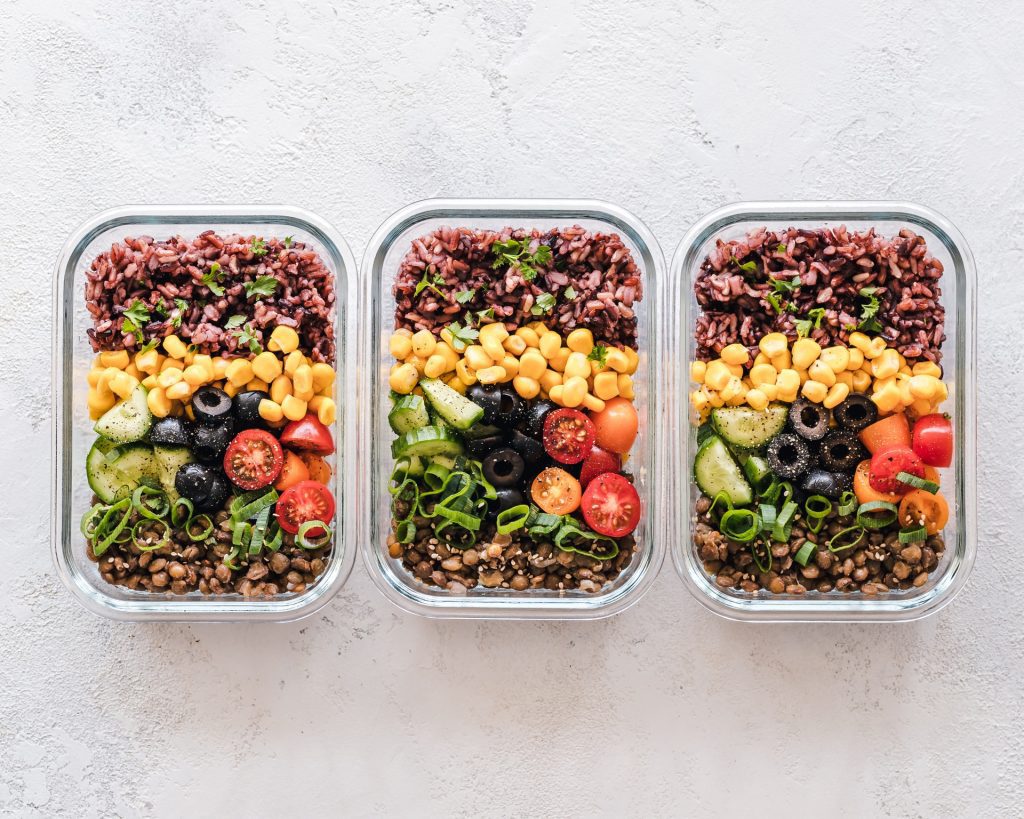
As with any other form of training, nothing will happen from all that lovely stimulation if you don’t feed growth. Your body needs fuel (carbs) to be able to train hard and to recover (protein). Aim for a surplus of complete proteins, making use of shakes and other supplements where needed. Drink plenty of water to give you energy and help you recover. Eat plenty of vegetables for fibre and complex carbs for slow release energy.
You are what you eat, so eat like an athlete.
We mentioned consistency and intensity above. Of these, consistency is probably the most important. You can’t beast yourself once this week, twice the next, do nothing the following fortnight, ad infinitum, and expect to see results.
Instead, results take time and patience. They take regular practice as you seek to make your body adapt. Exercise should be a habit, not a passion- only by changing up our habits can we bring about proper progression and growth, in any parts of our lives.
Bear all these in mind as you bring these exercises into your programme- push yourself hard in every set, burn your muscles out and improve strength and mind-muscle connection as you elicit hypertrophy, then go home, rest, eat well, and repeat. This is the recipe for success.
As promised, there are no machines or weights needed for these exercises. There is very little by way of equipment needed- other than something to hold onto and to rest your off-leg on. They all use hard leverages to bring about the required intensity, all employ asymmetry for balance, coordination (and to make sure as much of your bodyweight as possible is going into each muscle) and will all be sure to make you sweat and your muscles burn.
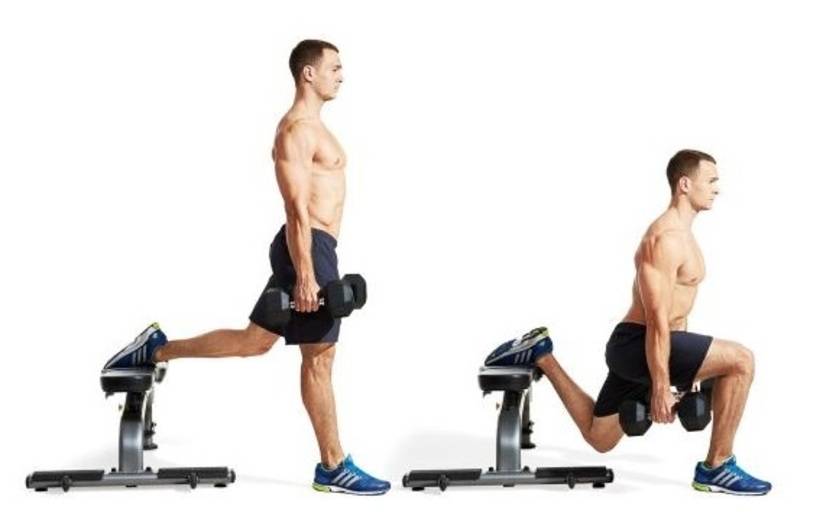
The Bulgarian split squat is one of the most deceptively challenging leg exercises you can find; simply by playing with the body’s mechanics and positioning can turn a regular looking exercise into a serious mass builder. Its unilateral nature means that most of the body’s weight will be driving down into the working leg, and that a fair amount of core stability and balance will be needed.
To perform a Bulgarian split squat:
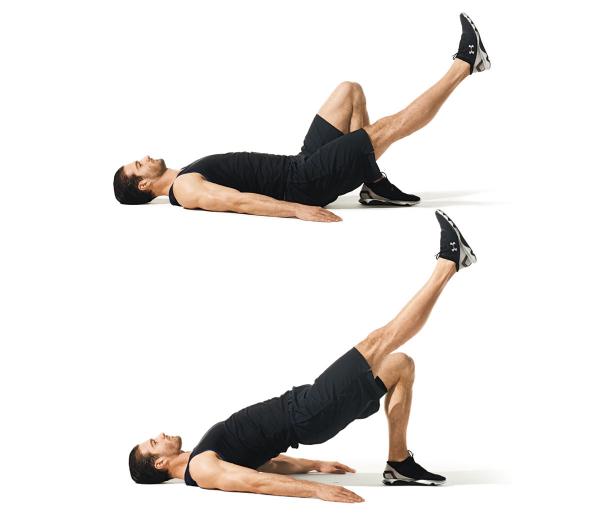
This is another one to really light up the posterior chain: single leg straight bridges target your rear muscles, bringing in the hamstrings, glutes and lower erector spinae. Though the front leg muscles are the most visible- notably the quads- this rear grouping is actually far more important for long term health, daily functionality and overall strength. Every time you bend over and pick something up, you’re relying on them, and a lack of musculature through the posterior chain is a lead cause of back pain, so it is incredibly important to work them.
To perform single leg straight bridges:
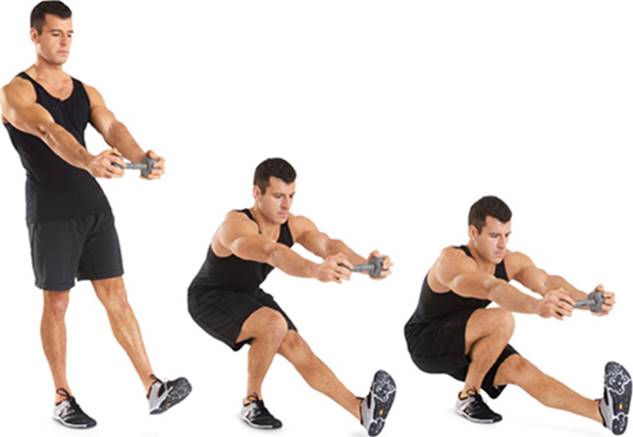
A third unilateral movement for your arsenal, single leg or pistol squats are a true test of strength and balance. There are few exercises that work so hard to elicit hypertrophy through the quads. The mind-muscle connection and balance that are both needed and built are phenomenal.
To perform a single leg squat:
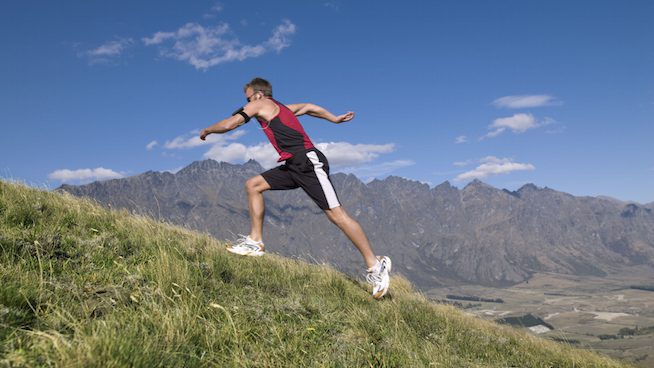
Most people think of squats and lunges when they are building their leg size and strength. This is fair enough- squats and lunges are key to eliciting strength gains and hypertrophy. However, sprints are also perfect for building muscle mass and improving aerobic capacity and power output.
Sprinting may not technically fit into most calisthenics arsenals, but they are fantastic for building real-world strength and fitness, as well as blowing up quad and glute size.
For sprints, simply pick a stretch of ground around 50-150m and run at full speed from start to finish. Walk slowly back to the start, recovering your breath, before going again. Try to keep yourself grounded, with no bounds, and breathe deeply.
To take this up a level, find a hill. Sprint up it. Your legs will be jelly afterwards.

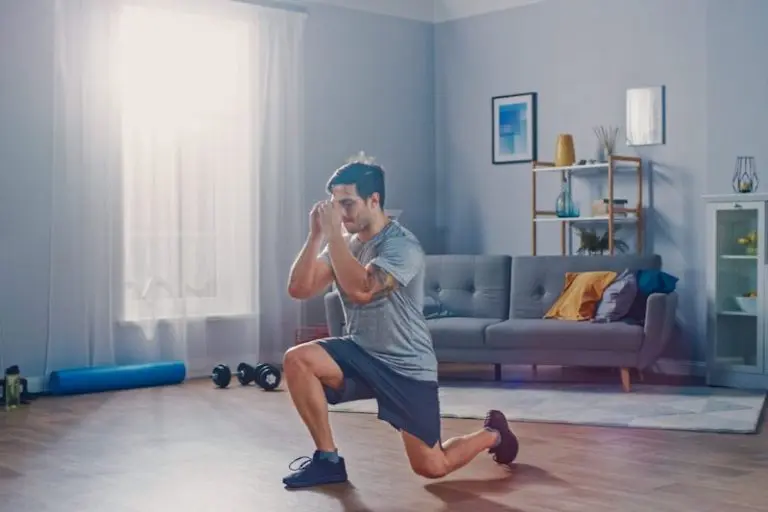
We’ve saved arguably the best for last: walking lunges are some of the best mass builders available to any athlete. They can be done anywhere, with little room and no equipment, and will build up full leg strength, endurance and mass. As a variation on the regular, static lunge, walking lunges work your legs unilaterally, as do the other exercises in this list. However, unlike regular lunges, walking lunges have you striding forwards, bringing in all of the leg muscles as well as the core, hips, and glutes in a major way.
To perform walking lunges:
Let’s put all of these exercises into the context of a sample training session, so that you can see how they can all work together to give you the best possible stimulation. We will begin at the top, with the largest, hardest movements, before coming down to something akin to assistance work, as any typical bodybuilding workout might be structured. Don’t hold back, especially with the earlier exercises.
You will need a stopwatch for this workout.
We will be starting with hill sprints, so find a reasonable incline that will have you running for 100m or so. Jog up to the top, keeping it light. At the top, complete one bodyweight squat, then walk back down to the bottom. Then repeat. For the second round, complete two bodyweight squats. For the third, three, and so on, up to ten.
Do as it says on the tin- sprint up the hill, aiming for that 100m point, or thereabouts. Stop at the top, walk down, and hit the stopwatch. Rest for 90 seconds.
You will be going for five rounds, pushing yourself as hard as possible each time, going as fast as possible. You should have jelly legs by the end, and that 90 seconds will seem to get shorter and shorter- your heart rate should be above 90% max by the end of this.
For a lighter version, try running on a flat surface.
You will need enough space to comfortable complete 20-30 walking lunges.
Use your stopwatch and time yourself for 5 minutes. Complete as many walking lunges as possible in this time, turning to come back on yourself as and when you run out of room.
Rest for 5 minutes.
Then go for 4 minutes, completing as many walking lunges as possible.
Rest for 4 minutes.
Then go for 3 minutes, completing as many walking lunges as possible. Go all the way down to one minute.
For a harder version, complete these on an incline. For a lighter version, try starting at 3 minutes, counting down for 3 rounds total.
You should be very tired by now, with your legs burning. We’re going to finish with a quick blast, using our three remaining exercises to make a giant set.
Making sure you have something to hold onto, and somewhere to rest your off-foot during the split squats, complete the following:
Single-leg squats (10)
Bulgarian split squats (10)
Single-leg straight bridges (10)
-rest for 90 seconds-
Repeat for 3 total rounds. Rep ranges given in brackets are per leg (so 10 single-leg squats on one leg, then 10 on the other, and so on.)
You shouldn’t be able to walk properly for a couple of days after first trying this one out. Remember, complete some active recovery, eat plenty of protein, drink plenty of water, and rest (it shouldn’t be hard to sleep for 9 hours after this!)
Training like this, with the kinds of high-quality exercises shown above, following conventional wisdom for hypertrophy, should see you making all the gains you could ever want, using only bodyweight, calisthenic-style programs.