The best online fitness resource you'll ever need. We filter out the BS to ensure you meet your health and fitness goals!
The best online fitness resource you'll ever need. We filter out the BS to ensure you meet your health and fitness goals!
We hear about the benefits of functional, compound movements all the time. There is good reason for this: they are practical, have great carry over into everyday life, and are very efficient for those looking to get fit and strong. However, there is also a place for isolation movements.
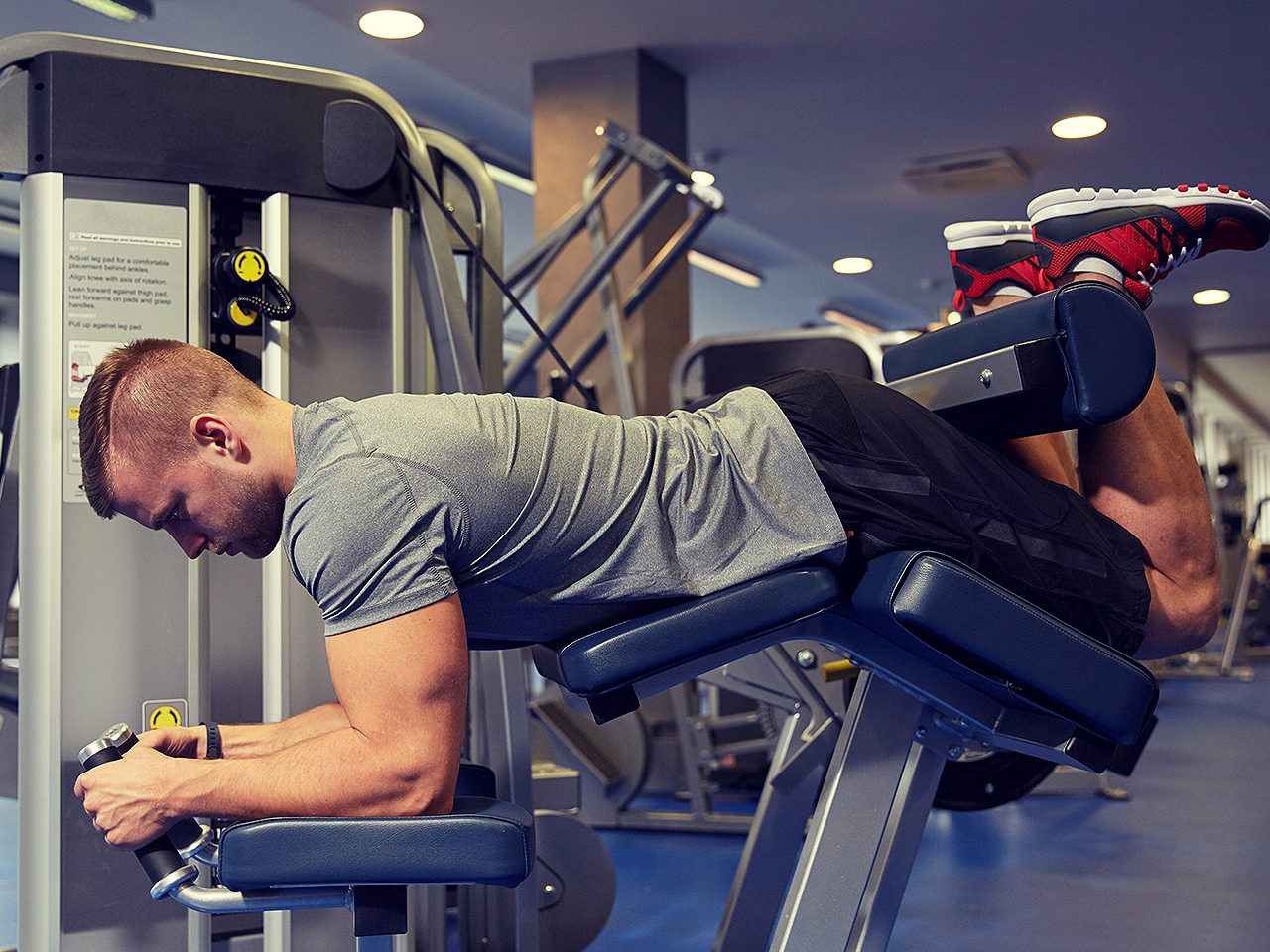
Chief amongst the lower body isolation movements is the leg curl. It elicits hypertrophy and strength in your hamstrings and can be done with little central nervous fatigue for very high rep ranges. It deserves its place in anybody’s fitness regime who is looking to increase leg size and the amount of weight they are able to shift in their squats and deadlifts.
Alongside the reverse hyper extension, the leg curl is a key tool in your posterior chain arsenal.
However, as with anything, too much of one thing can be exactly that… too much. You may get bored with the leg curl, you may not always have access to a leg curl machine, or you may want to bring in other muscle groups, gradually adding extra muscles and joints so that you can really test what your hamstrings and, by extension, your lower body’s mechanisms, are capable of.
With this in mind, here are 12 leg curl variations. Some are isolation moves. Some, like the deadlift itself and various Olympic lift variations, are full body movers that work your posterior chain (of which you hamstrings are a key component) under great load. All deserve consideration for your training regimes, and all will bring their own benefits to your legs.
We’ll start with some variations on the leg curl that use different pieces of equipment and bring different muscle groups in to play, before moving onto some alternatives to the leg curl.
This will work the hamstrings in a similar way to the leg curl. However, it will also bring in a major core component, as is often the case when you include gym (or Swiss) balls in your training. This exercise will be perfect for the latter portion of your training session, as you look to isolate your hamstrings and tire out your abs.
To perform the gym ball leg curl:
This is a step up from the gym ball leg curl as it puts an even greater degree of stress into your core. The TRX hamstring curl is another exercise that you will want to include towards the end of your workout, finishing off your core at the same time as pumping up your hamstrings.
To do TRX hamstring curls:
Sliders are a good recommendation for any public or home gym due to their versatility. One of their better uses is for machine free leg curls, once more lighting up your core muscles and your hamstrings.
To do slider leg curls:
This movement is a lot like the slider leg curls we looked at above. The only difference is that you use a towel on a low-friction floor. As with the slider leg curl, it works your hamstrings, glutes and core.
For hamstring towel slides, perform as above, swapping out the slider for a towel. It will be more unwieldy than sliders, and so can be considered a slightly more advanced, much more core intensive exercise.
Now we’ve seen some variations on the traditional leg curl, let’s look at some alternative movements that will stimulate your hamstrings and posterior chain through a mixture of different stimuli and angles.
Hip thrusts work well, but to really zero in on the hamstrings the single leg hip thrust is the best bet. This move doesn’t require any equipment (though as you get more proficient it may be worth adding some kind of weight to your hips) and will isolate the muscles we want to work unilaterally, placing them under a great load.
To execute leg hip thrusts:
Now we’re getting into the really tough exercises. Nordic curls are sometimes called the kneeling leg curl, because they use similar motions to the leg curl. However, the stimuli is greatly increased. You will need a partner to assist you, or at the very least something to anchor your feet to the ground.
To do Nordic curls:
Kettlebell swings are a favoured exercise in many HIIT and circuit routines. They are also great primers for larger exercises like rack pulls and deadlifts (see below) and are amazing for building up hamstring explosiveness and core strength.
You don’t need to pick too heavy a weight to start with. Try 4-8kg for higher reps (20 or so, or try going flat out for 30 seconds), before taking it up to around 20-28kg in time.
For correct kettlebell swings:
Perhaps the ultimate deadlift accessory, good mornings are great at building up your posterior chain, with great emphasis on your hamstrings. You can do them with a barbell or with dumbbells, though it’s crucial to begin with lower weights as you practice getting your form right.
For your good mornings:
We’ve seen a good sample of exercises that really get into your hamstrings in a variety of ways.
However, there are some fantastic, big compound movements that you should definitely be including in your routine if you’re looking to build a strong posterior chain with decent hypertrophy across your hamstrings:
Let’s keep the description brief, as most of the technique will be covered in the following deadlift section. However, for rack pulls, you want the bar elevated (either on the rack, giving it its name, or else stacked on some plates or blocks.) It can start from anywhere from just below the knees to just below the hips and should be loaded heavy (more so than even your deadlift itself.)
Low reps work best, aiming for 1-5, and you will want a double overhand position.
This is Mecca, arguably the ultimate exercise for posterior chain development. It brings about a healthy amount of hamstring growth, and a serious degree of strength improvement. However, the movement itself is very involved- if you’re ever going to pay a trainer, do so now and have someone demonstrate how to deadlift correctly.
In brief on the form, however, let’s break it down into three parts:
After this, lower the weight. You don’t want to bear the weight as you do this- there is no concentric phase to the deadlift. Instead, let it fall down to the ground, using just a little strength to control it. Hinge at your hips, bend your knees, and lower your chest until you’re back at the beginning.
Deadlifts should be performed under very heavy loads, for very few reps. 1-6 reps is common, working up to a maximum load for as many sets as is appropriate.
This is very similar to the regular deadlift. However, rather than bending your knees, you keep your legs straight. This will mean you use much smaller loads, but it really isolates the force into your hamstrings.
If you struggle to get to the ground with your knees straight, try raising the bar on blocks.
For another variation, try the Romanian deadlift. This is much like the stiff legged deadlift, but you don’t touch the bar to the floor between reps. Bring it down as low as is comfortable, perhaps to within a half-foot from the ground, and then return to standing.
This is a variation on a classic Olympic lifting movement: the clean. It’s particularly good for explosive power in the posterior chain, meaning that your lower back and hamstring interaction will benefit greatly from performing it.
You can go for high reps, but usually Olympic moves like this will be done for singles, or for low reps at the least. Aim for 2-3 reps for 5-6 sets.
There we have it, 12 alternatives to the leg curl. All are good when used in conjunction with the leg curl, and all will bring you something different and more. Begin your workouts with the larger movements (deadlifts, rack pulls, cleans, good mornings) and end with the smaller ones (leg curl variations and so forth) so that you maximise muscle recruitment early on, before ending on a pump.