The best online fitness resource you'll ever need. We filter out the BS to ensure you meet your health and fitness goals!
The best online fitness resource you'll ever need. We filter out the BS to ensure you meet your health and fitness goals!

BCAAs are becoming ever popular as more people take up high intensity sports like barbell athletics, and as research into both BCAA recipes and usage expands. You can’t go into any supplement shop either on the high street or online without seeing various different types, brands and combinations of them.
From athletic performance to exercise recovery, BCAAs are being touted as a must-have for your supplement cupboard. They can help you lift more, run faster and for longer, and can reduce the fatigue that would usually bring you crashing down in the days following an intense bout of training.
But what are they? What are they for? And do they deserve their reputation as one of the leading types of supplements available today?
Read on to find out in this BCAA 101.
BCAA stands for Branched Chain Amino Acids.
All proteins are made up out of twenty amino acids. Three of these are leucine, isoleucine and valine, and these have branched, chain structures: hence, branched chain amino acids. These are the three amino acids we will be talking about in this article.
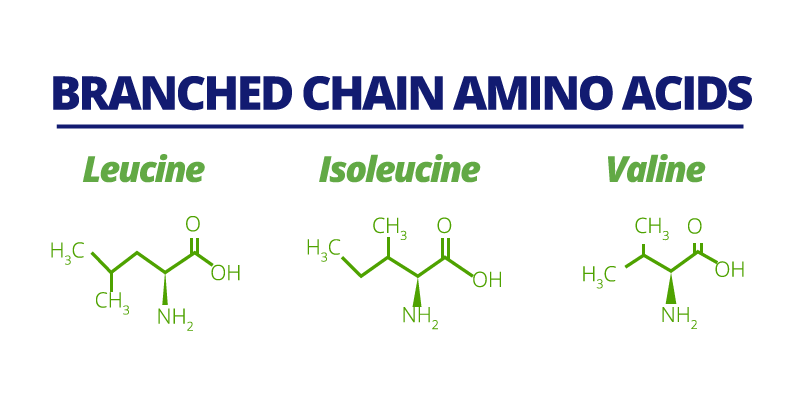
The main thing you need to know right away is that branched chain amino acids are three of nine essential acids. This means that the human body cannot produce them, so needs to source them externally through diet. This is why supplementation is so key with regards to BCAAs.
What does this mean, though? Don’t worry – BCAAs are not hard to find. They can be found to some degree or another in most protein rich foods. If you’re eating a good variety of high quality, complete proteins, the chances are that you are getting enough BCAAs into your system to be getting on with.
However, a lot of people do not eat a wide enough range of good quality protein to get our ideal allotment of BCAAs. This especially applies to those athletes who need a particularly high protein diet, like weight lifters or sprinters, as they likely will not be getting the volume of BCAAs they need to cope with recovery. It also applies to vegetarian athletes, as veggie protein sources are typically quite low on BCAA content.
I will, of course, go into this in more detail later on when I get onto the nutritional and health benefits of BCAAs. However, briefly, as with all other types of protein, BCAAs are the building blocks of muscle. Insufficient protein intake after exercise will mean that you cannot grow muscle, and this includes BCAAs. As I mentioned above, the human body cannot synthesise its own essential proteins, so it needs to take them in through dietary sources.
Now that we have the basics covered, and before we get into the nitty gritty of what they are and how we can use them, let’s first look at a few interesting facts about BCAAs so as to better acquaint ourselves with them:
So, we largely now know what BCAAs are, their purpose, and a few pieces of information, but what does it all really mean? How can you benefit from including BCAAs in your diet or supplement regime?
The thousands of different proteins present in the human body are all made up of twenty basic amino acids. As I mentioned above, some of these are essential: they cannot be made by your body and so must be taken in through dietary sources. There are nine of these essential amino acids, of which the BCAAs leucine, isoleucine and valine are three. They are vital to the success of any training regime, for reasons that will soon be clear to you as you read my health guide below:
One of the main uses of BCAAs is in hypertrophy training: it greatly aids in the increase of muscle mass. The amino acid leucine in particular stimulates muscle protein synthesis, which is the process of building new muscle. In one study, participants who drank 5.6 grams of BCAAs immediately after resistance work increased their rate of muscle protein synthesis by over a fifth on average, compared with those who consumed a placebo.

However, other studies have shown that participants who drink whey protein shakes containing similar amounts of BCAAs increased this rate by up to 50% more than those who only took BCAAs alone. Whey protein contains all nine essential amino acids needed to build muscle, not just the BCAAs. Whilst BCAAs can improve muscle protein synthesis, greater effects can be achieved with the full compliment of amino acids.
Similarly, BCAAs can help in the prevention of muscular wasting and breakdown. Muscle proteins are constantly synthesized – essentially, they are continually broken down and rebuilt. The amount of protein within the muscle depends on the balance between muscles protein breakdown and muscle protein synthesis.
Muscle wasting presents itself when protein breakdown is greater than muscle protein synthesis.
BCAAs make up 35% of the essential amino acids found in muscle proteins, and 40% of the total amino acids that your body requires. It is therefore very important that BCAAs are replaced when muscles are under stress, alongside the other six essential amino acids. This will help to arrest muscle wasting.
Anybody who has done any amount of serious training will know the frustration of waking up in the morning following a hard session with DOMS (delayed onset of muscle soreness) plaguing them. It typically develops between 12- 24 hours after training and can last for several days. BCAAs can help to decrease this muscular soreness post-training.
The exact cause or causes of DOMS is not clearly understood. However, many authorities concur that the tiny tears in the muscles after physically stressing them is a major contributing factor. BCAAs help to decrease muscle tissue damage, which should help to mitigate and reduce the length and scale of DOMS. Several studies show that BCAAs help to decrease protein breakdown during exercise, as well as decreasing levels of creatine kinase, a key indicator of muscle damage.
BCAAs may also aid in reducing fatigue from exercise. Just as you will know the frustration of DOMS if you train on a regular basis, you will most likely have also experienced fatigue and exhaustion from training. How quickly you succumb to fatigue will rely on several variables, including the intensity and duration of your training sessions, the conditions in which you train and your diet. BCAA intake will also contribute as a variable.
Your muscles need BCAAs during training. They use up your reserves, causing a decrease in BCAA levels in your blood. When this happens, the levels of the essential amino acid tryptophan in your brain begin to increase. This is then converted to serotonin, which, as I mentioned above, is a contributing factor to the perception of fatigue during exercise.
Studies have shown that subjects who supplemented with BCAAs saw a marked increase in their mental focus during exercise. Whilst this is unlikely to have too much of a bearing on your exercise performance, it will aid in longer term focus as your perception of tiredness is lessened.
Not all products are born equal, and this is certainly true of commercially sold BCAAs. With a wealth of conflicting advice, research, and branding, it might be hard to sort the wheat from the chaff and learn how to properly pick the right product for your needs.
Don’t worry, I’ve got you covered: there will be some things that you want to look out for when shopping for BCAAs, and I’ve compiled a list below.
Primarily, when choosing your BCAA supplement(s), the main thing you want to think about is what you want to get out of the product. This should guide your search. For instance, are you trying to keep to a stricter budget, whilst still going for the benefits of BCAA supplementation? Or perhaps you want the best possible product, or a tasty flavour, or something more specific that fits with your personal dietary requirements.
Either way, work this out first. When you have, you will be in a better place to choose the right BCAA supplement for you. Look for a product that has the amino acids leucine, isoleucine and valine. There will be a host of supplements offering different combinations, with different additions. Some of these may suit you, depending on your needs – green tea or ginseng for weight loss, for example – but make sure that the fundamentals are right: make sure that all three BCAAs are present.
Other than this, there are a couple of other considerations to bear in mind:
BCAAs are used by your muscles as direct sources of fuel during intense training, so getting the ratio right is important.
There will be some products that overly favour leucine, sometimes even going as high as 10:1:1. However, you want to go for something more like 2:1:1, in leucine’s favour. This will increase the amount of energy that you have, whilst decreasing the levels of fatigue that you might experience.
Of course, this one is entirely subjective and depends on your own tastes and preferences. A lot of commercial BCAA products come with a fruity or citrus flavour, which can be particularly refreshing during an intense training session.
So, we know a fair amount about what BCAAs are, and what they do, and what to look for: but how do you integrate them into your diet? What are the best ways to supplement your current regime with them?
Please, read on to find out more about how to include BCAAs in your nutritional intake:
You will typically see BCAA supplements in two forms, as either a capsule or as a powder. Capsules are arguably more convenient, as you can just pop a couple pre- and post-workout. However, the powder is also easy enough to use and can come in an array of nice tasting flavours.
You would usually be looking to take in about 6g per serving of powder, though you would need to take more when going for tablets or capsules to compensate for other ingredients used.
BCAA powder and/or capsules can be taken 2-4 times per day. You would normally take them 30-60 minutes before and immediately after a training session, as I mentioned above. Some training plans and nutrition plans will also call for you to take BCAAs during the session, at which time flavoured powder mixed into your water will make a nice, refreshing drink.
It might also be a good idea to take your supplements first thing in the morning, to get you started on your daily intake, or last thing at night, so that you have plenty of BCAAs for muscular repair as you sleep.
There is obviously no exact dosage that will be suitable for everybody. However, a good rule of thumb is to take between 0.03-0.05g per kilogram of body weight per hour, or 2-4g per hour during exercise and immediately post-training.
As above, mix your BCAA with water to take during training, or to sip throughout the day, and try adding some to your post-workout protein shake to really bump up the volume of your essential amino acid intake.
BCAA supplements aren’t appropriate for anyone under the age of 18, those with ALS or women who are pregnant or breastfeeding, as not enough is known about potential side effects. BCAAs can also affect blood sugar levels, so individuals with diabetes should consult their doctor first before taking BCAAs.
Pros:
Cons:
So, that’s me finished with my BCAA 101 for the time being. I have hopefully covered all the basics, and a bit more, surrounding branched chain amino acids; hopefully, you are more clued in to the potential health benefits, risks, and ways of using them than you were before you read this article!
BCAAs are a definite must-try for anyone serious about improving their athletic performance and building muscle. Tough don’t forget that, fancy though they might look, bottles and packets of supplement are not the be-all and end-all; if you already have a high protein, varied diet, the chances are good that you will already be reaping most of the benefits to be had from BCAAs.
Either way, why don’t you let us know? Have you tried them, or will you? Or have you found that BCAA inclusion in your supplement regime has given you any kind of athletic edge?
If you have any thoughts, advice (or even any recipes for BCAA shakes!) please feel free to put them in the comments below.