The best online fitness resource you'll ever need. We filter out the BS to ensure you meet your health and fitness goals!
The best online fitness resource you'll ever need. We filter out the BS to ensure you meet your health and fitness goals!
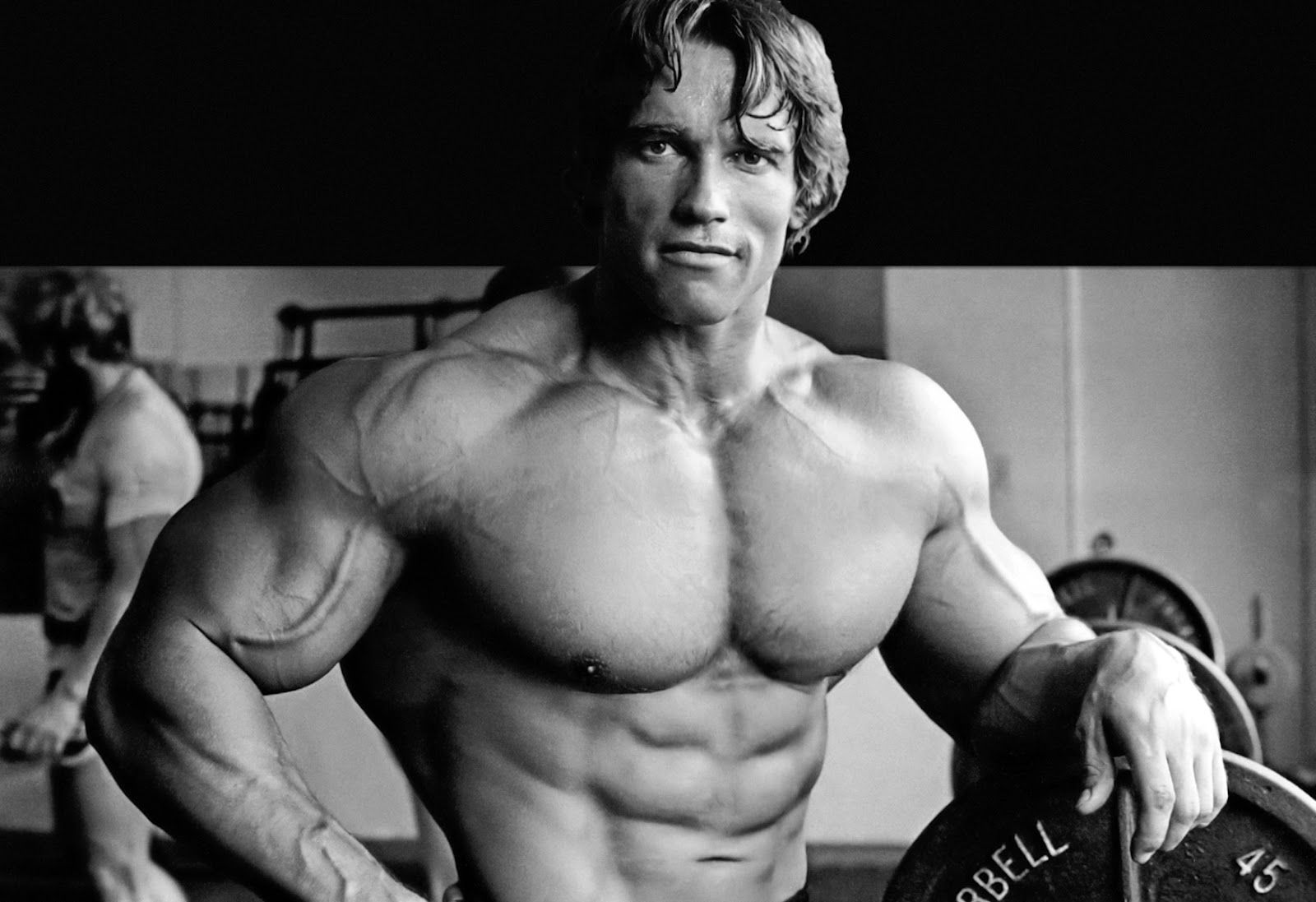
Whether you’re training for aesthetics- wanting a muscular, toned physique- or for performance- going for a functionally strong torso- you will want to develop your chest. This means working your pectorals hard, through a range of motions and stimuli.
However, there are too many types of chest exercise to count, and it can all be a little overwhelming as you try to program your training sessions. Presses are a good bet: bench press, chest press, push ups and dips should all form core parts of your chest routine. However, for a bit of extra pump- to really put the stimulation into your pectorals in near enough isolation- pec decks are a firm favourite in gyms around the world.
Pec decks do a good job of isolating your pecs, meaning that you can really work on muscular contraction, neuromuscular control and vascularity across them. They are also perfect for all levels: experienced athletes can make the most out of them, but so can beginners, as they take a relatively low amount of skill or experience to perform correctly.
In this article, we’ll look at some of the benefits- and some of the downside- that come with using the peck deck, as well as going through proper form and programming best practice.
Pec decks are amongst the best machines for specificity when it comes to training the upper body. They are designed solely to allow you to increase the strength and size of your chest muscles. Specifically, it works the pecs (hence the name), though a fair amount of stimulation often also goes into supporting muscles like the anterior deltoids: all the muscles that are used when bringing your arms together in front of your body see some use with the pec deck.
With this in mind, the pec deck is indeed amongst the best exercises you can find for eliciting hypertrophy in your pectorals. It additionally strengthens your torso and brings a great stabilising factor to your shoulder blades, opening up supporting muscles like the serratus anterior for activation.
The movement itself is simple and, as it’s a machine with limited range of motion, hard to get wrong (though it’s best to begin light as you get used to it.) Whilst complex compound exercises like the bench press or dip take a fair amount of skill and practice to complete safely and effectively, the pec deck can be used from day one by any beginner in the gym.
This all being said, let’s look with a little more detail at the pros and cons of including the pec deck in your regular workout programming.
There are a number of advantages to be gained from regularly using a pec deck machine. If you perform the exercises well, under control, and keep the movements steady, the pec deck will allow you to reap a great many rewards:
However, there are some disadvantages to using the pec deck. In fact, many trainers and athletes swear off them entirely, and their carry over into functional athleticism and actual strength gains are questionable (CITE.) They can be considered unsafe at the worst and ineffective at the best.
The cons of using the pec deck include:
Every exercise will have its own pros and cons. So too will every machine (and a large con with a machine is that it’s a machine, with limited function and range of motion.) However, it’s ultimately up to whomever is writing your programme- or even you, yourself- to decide what to include. The pec deck has its place, and can be used to great effect: just don’t rely on it, overuse it, or build a workout around it.
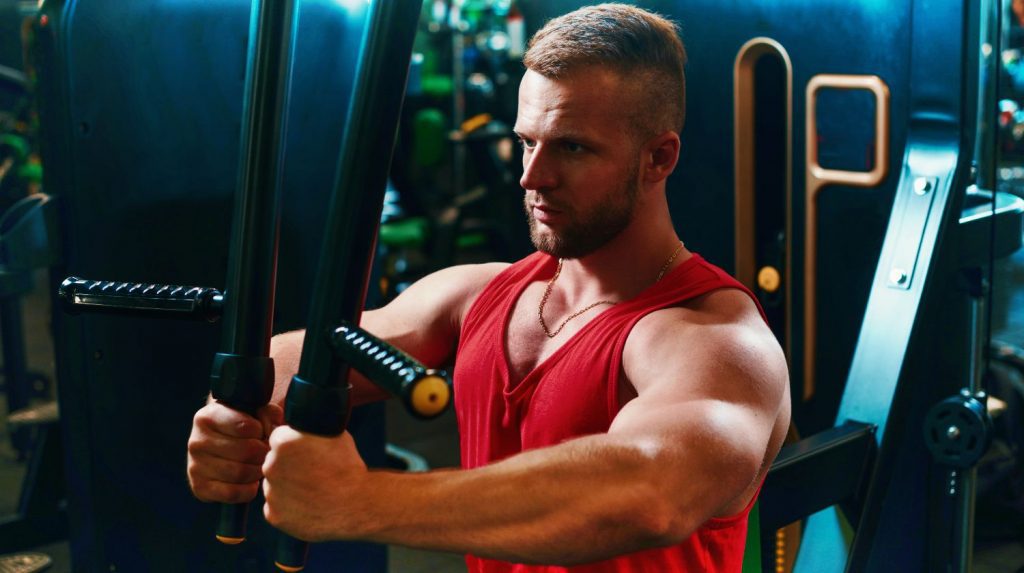
The whole point of resistance machines is that they are easy to use. Beginners and untrained individuals can jump straight on them and get something of a decent workout without having to learn any of the big lifts or figuring out how to navigate the weights room.
The pec deck is no different: it’s easy to use and hard to mess up.
However, there are some tips to follow when you’re using it. To properly execute pectoral flyes on a pec deck:
There are some common mistakes that beginners- and some more advanced athletes- typically make when using the pec deck. These include
This isn’t a power move in which a good breath and brace is needed. You shouldn’t be tense at all, nor should you cut off your oxygen flow- you have lots of reps to get through. Breath out slowly as you bring your hands together, breath in again as you release them back to the starting position.
Again, this isn’t the bench press where leg drive is a much-needed element. It’s an isolation move and should therefore be used to isolate the pecs. Don’t use your legs. If the weight is too high to shift it with your arms alone, bring the weight down. All effort should be coming from your pecs.
It may also be tempting to press into your feet to steady your body and give that closing movement more power. But remember, the purpose of this exercise is to train the chest muscles, not your legs. If you notice that you are using your legs to gain momentum, decrease the amount of weight you are lifting.
One last time, this isn’t the bench press: you don’t want an arch in your back. Your back should be flat against the seat and well-supported. If you can’t manage this, it’s because the weight is too high and you are trying to compensate using favourable body mechanics. Bring the weight down.
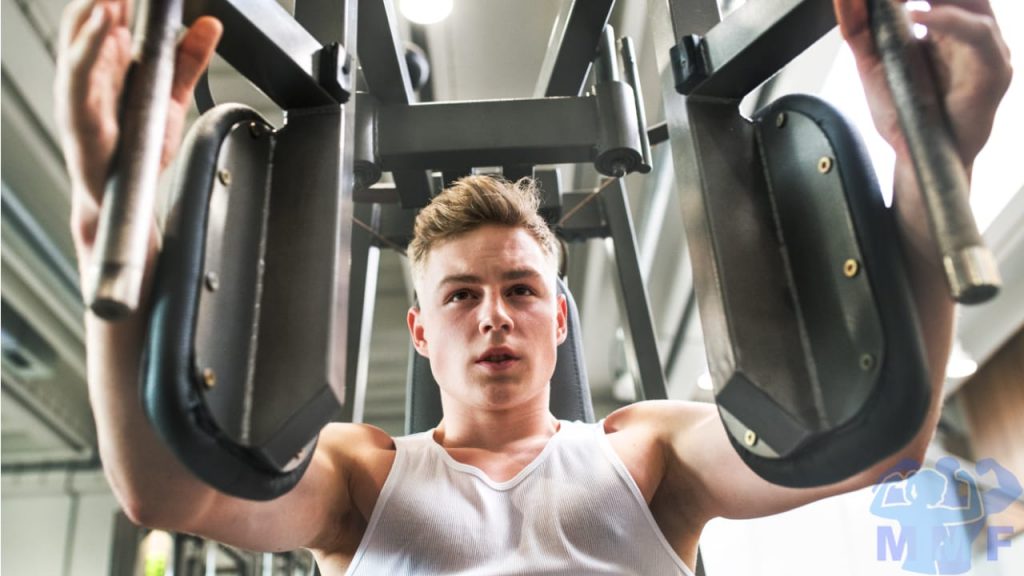
Not all machines are created equal, and not every lifter needs the same thing: there are plenty of different ways of performing a chest flye, both with a pec deck and without.
Let’s start with modifications and variations of the pec deck. Some will have different attachments and positionings, some will use different mechanisms, and some will put you into different positions. For example, it’s common enough to see both variations in which you have to hold onto handles to move through the exercise, and variations in which you line your forearms up on pads. Some will give you an adjustable seat, whilst some seats will be fixed and the mechanism itself will be adjustable.
However, the same basic rules will apply: follow the technique listed above and you shouldn’t go far wrong. If in doubt, always feel free to ask a trainer or member of staff to show you how you local gym’s pec deck works.
There are also different things you can do with a pec deck. Two of the most effective variations include:
There are other ways to perform flyes. Perhaps you don’t have access to a pec deck: you train at home, where equipment is limited, or your gym simply doesn’t have one. Don’t worry: there are plenty of ways to hit your chest.
To replicate the effects and feel of a pec deck, you can:
And there we have it: everything you need to know to begin using the pec deck. You should hopefully know a little about the uses, pros and cons of the pec deck, as well as how to go about setting one up and incorporating it into your training regime.
If your gym doesn’t have a pec deck machine, or if you read the cons list and decided you wanted to try something different, the above exercises should all elicit similar results in terms of hypertrophy, strength gain and muscular activation.