The best online fitness resource you'll ever need. We filter out the BS to ensure you meet your health and fitness goals!
The best online fitness resource you'll ever need. We filter out the BS to ensure you meet your health and fitness goals!
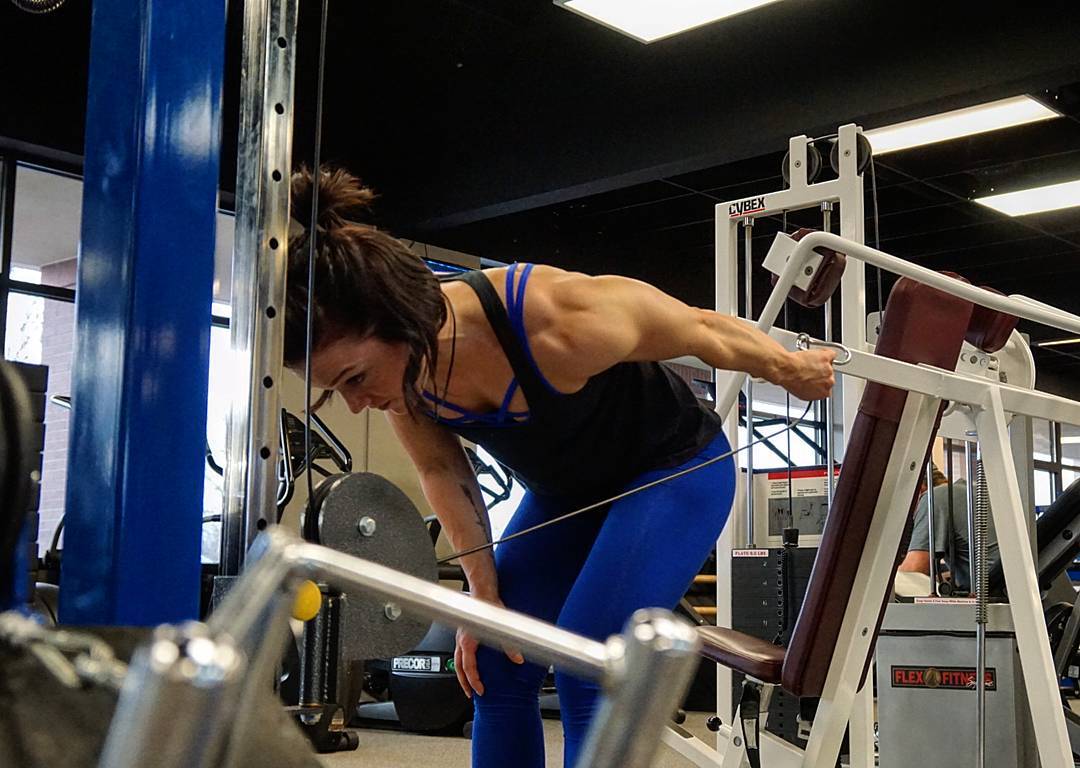
The Cable Tricep Kickbacks have emerged as an isolation exercise of choice for both men and women who want to develop the unmistakable “horseshoe” on the backs of their arms.
There are anatomic, physiologic, and biomechanical reasons why the Cable Tricep Kickback can work so well for this, and it begins with the purpose of the triceps.
The triceps muscle has a very simple job in life, that is it extends the forearm. That’s it: move the forearm from totally bent to totally straight…or positions in-between.
Knowing what the triceps is intended to do empowers you to think critically about how best to work it, therefore making the cable tricep kickback a fine way to do that.
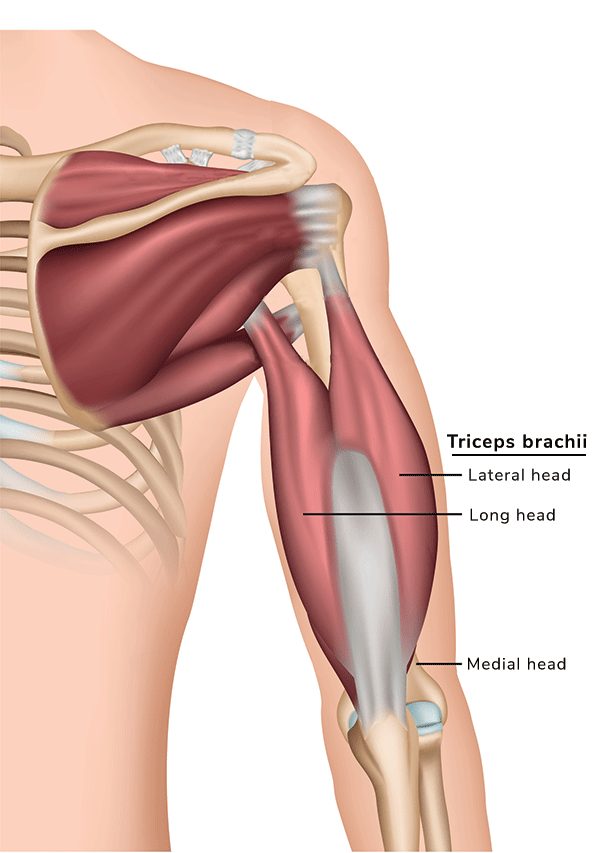
Triceps Anatomy Terminology (three headed origin)
Triceps comes from the Latin meaning “three-headed”. “Triceps” always ends in “s” because the singular form is triceps, as is the plural. There’s no such thing as a “tricep” although misuse is so widespread that exercise scientists are giving up the fight for the correct usage of the word.
Cable tricep kickbacks are a bodybuilding exercise but it doesn’t mean that you have to be a professed bodybuilder to do them. They’re useful for developing hypertrophic triceps, although slower eccentric with a slightly more rapid concentric is appropriate cadence as well.
Execution of the exercise is best done using a rhythmic pumping motion because jerking the weight as if it were a plyometric exercise kind of misses the point.
If you’re looking for an exercise that bulks up and chisels that horseshoe on the back of the arm, or, just makes it more shapely and toned (something the ladies frequently want), you could do a lot worse than the Cable Tricep Kickback.
The Cable Tricep Kickback is an adaptation—and an improvement—of the traditional dumbbell kickback.
These are because of three reasons:
There’s a fourth bonus reason. You can still pause and hold the cable at the end of the pull for an isometric bonus if you like, just as you would a dumbbell.
The cable variant is similar in almost every way, except that the triceps muscle stays under load throughout the range of motion, whereas in the dumbbell version, the triceps is really only loaded for a short fraction of the movement.
When using a cable, the upper arm stays loaded throughout the concentric phase and remains loaded throughout a much longer eccentric phase.
The cable machine enables the triceps to stay under tension until the forearm is fully flexed where the hand is at the shoulder. A realistic full range of motion (ROM) is somewhere around 160°, which is a very wide ROM. A full 180° would be physically impossible due to elbow structure, biceps, and other soft tissues on the front of the upper arm.
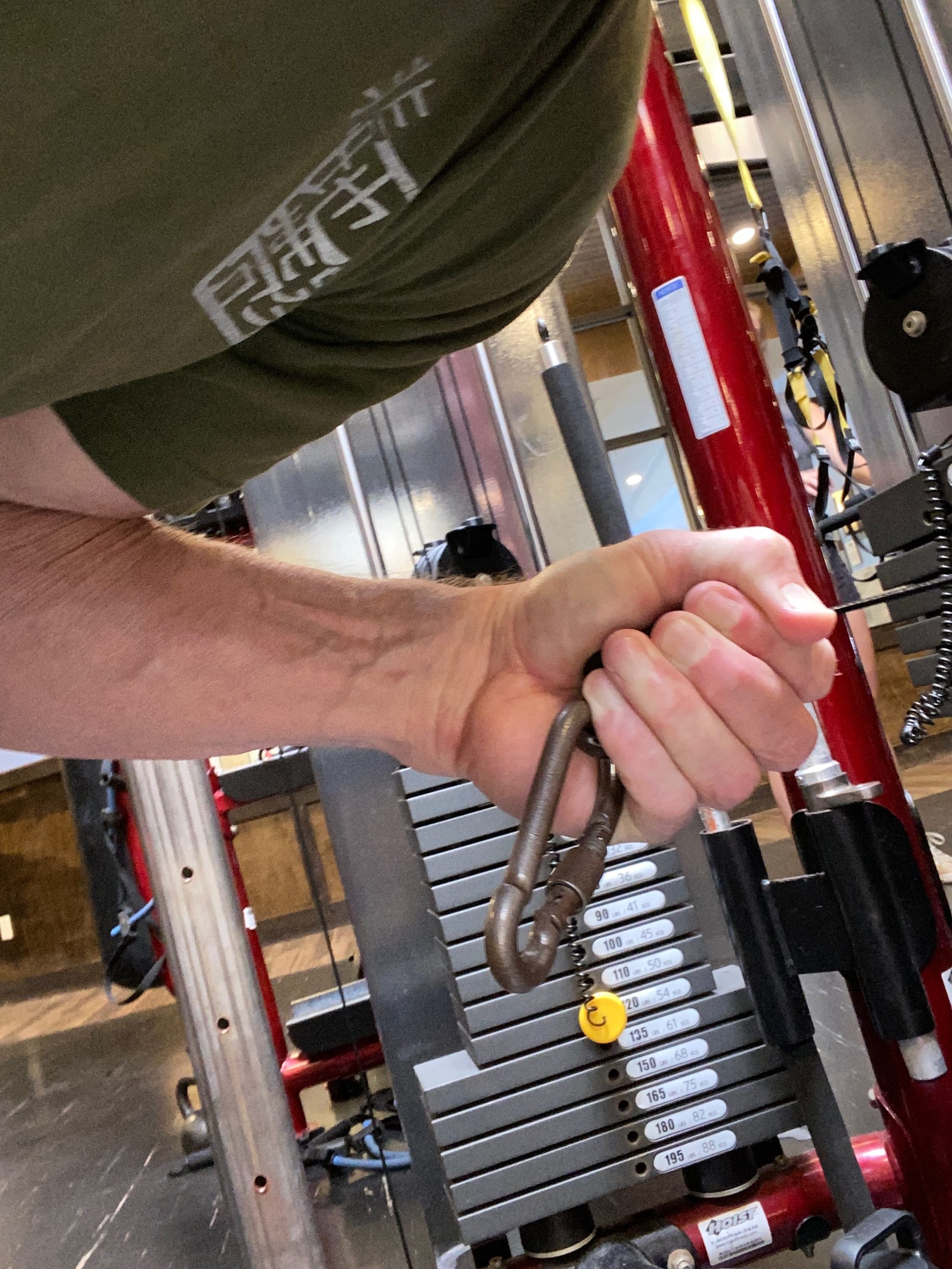
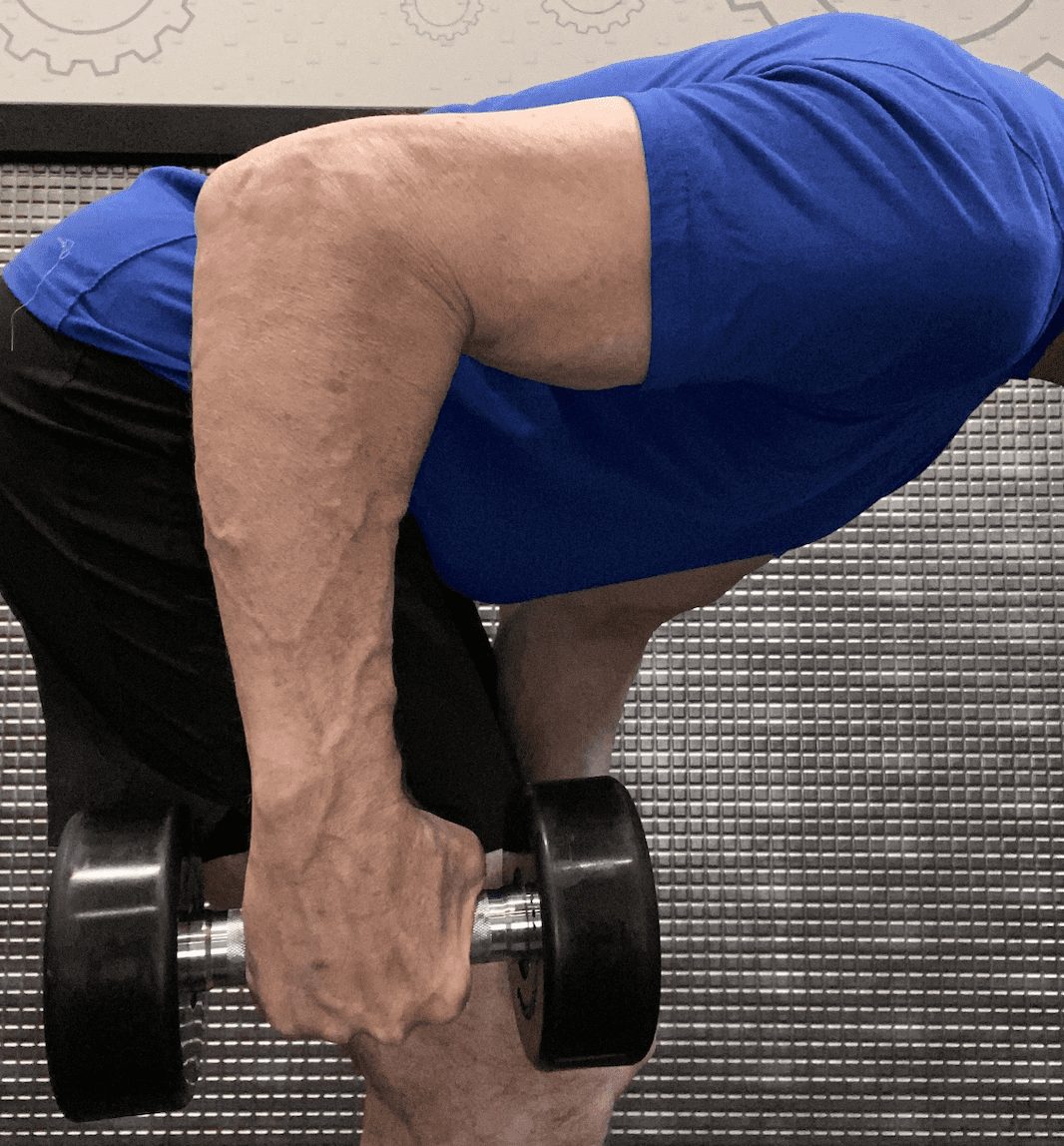
Comparing the Beginning Positions and Resulting Potential Ranges of Motion
This degree of ROM is impossible with the dumbbell kickback unless the lifter could somehow position themself upside down.
In the dumbbell triceps kickback, the torso is roughly parallel to the floor. The dumbbell hangs at the forearm’s length and then is pressed backward (or “kicked back”) toward the hip.
The forearm hangs straight down in this starting position, therefore parallel to gravity, and under zero load. Think of a pendulum suspended from a rod. The pendulum is completely at rest and not swinging, without stored or kinetic energy.
The only muscles working to support this position are the hand and forearm muscles that are gripping the dumbbell, and the posterior delts holding the upper arms parallel to the ground. The triceps is completely at rest in this starting position. You can pretty much stay like that all day long without your triceps getting tired.
In this forearm down-hanging position, the max ROM available is 50%. Then, if the lifter’s upper body is more upright than the parallel, the ROM decreases, because the forearm is then less than 90° in relation to the upper arm.
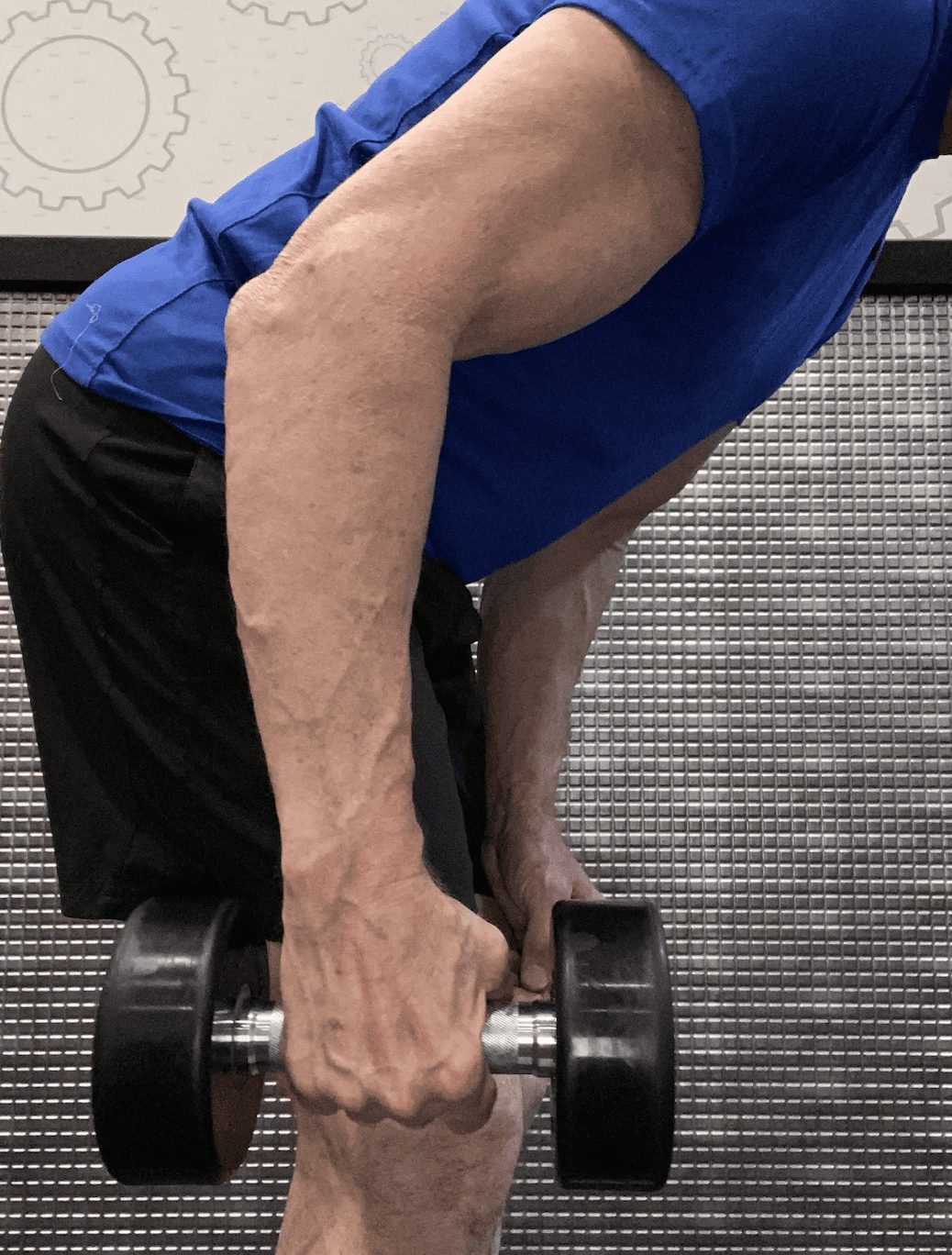
The triceps actually only works for only a fraction of a dumbbell kickback.
Lifters will sometimes flex the arm, by bringing the forearm up toward the shoulder. To do this, the biceps and brachialis must do the work, and that shuts down the triceps due to the neuromuscular phenomenon of reciprocal inhibition.
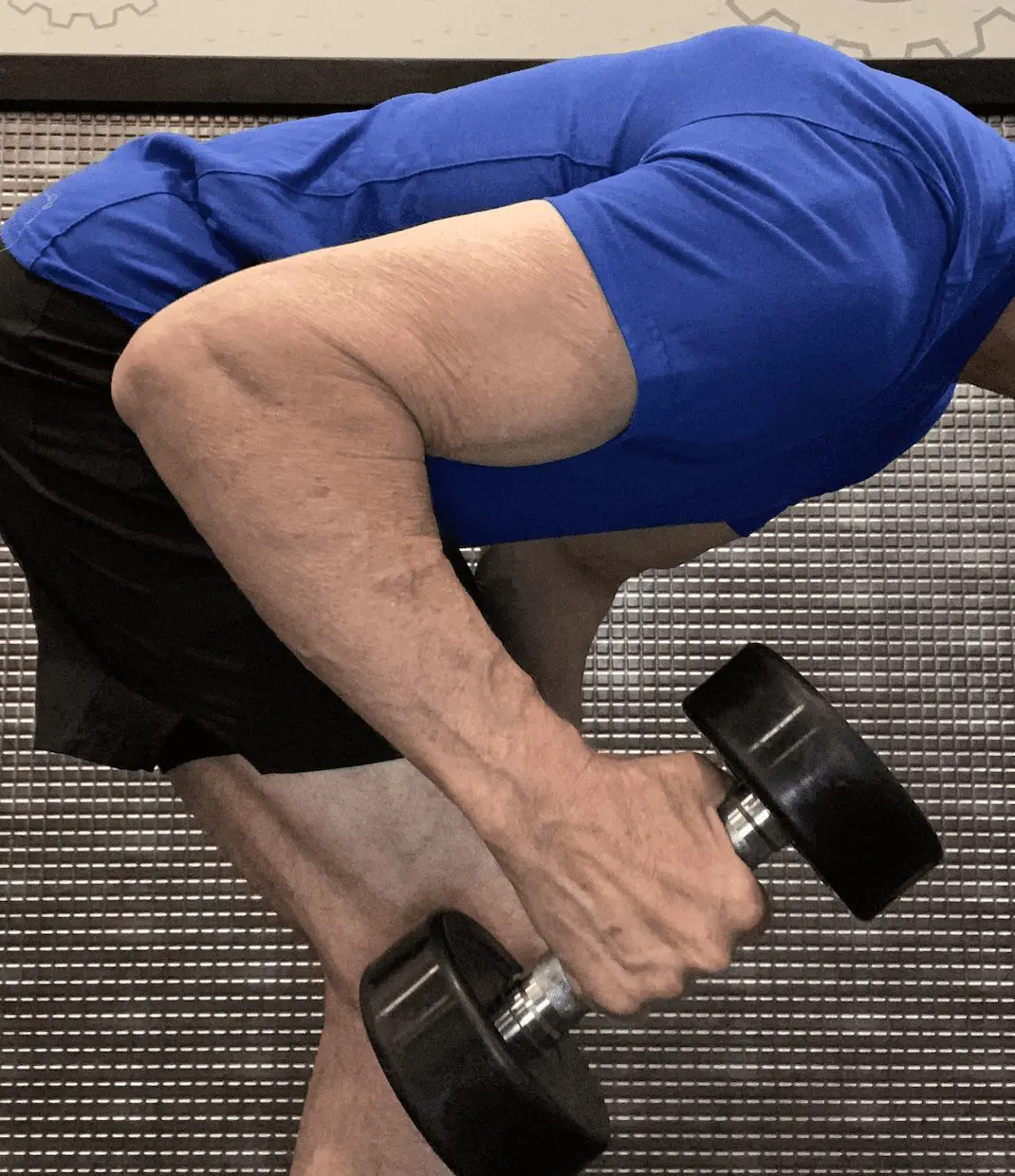
Reciprocal inhibition is a neuromuscular phenomenon that causes the muscles on one side of a joint to relax so that the opposing muscles can work.
To put some numbers to what happens when the dumbbell is swung up toward the shoulder:
The constant tension of the Triceps Cable Kickback keeps the triceps under load and the biceps relaxed throughout an entire range of motion, therefore making it a far superior move for the back of the arm.
A cable machine frees you to orient your body in a number of different positions relative to the cable and pulley, and as long as the direction of resistance is opposite your angle of pull, you’re set to work the muscle optimally.
Precisely the same motion can be done standing as it can be when bent forward, DB kickback-style.
Whereas free weights are completely dependent on gravity, cable machines are not.
When using free weights, the lifter must position themself between the downward force of the weight and the floor such that the muscle and the weight are opposite gravity’s pull.
Cable machines are also gravity-agnostic. The pulley system manages the downward force of gravity and you get the luxury of positioning your body against the cable’s resistance. Your job is then only knowing how to align the target muscle so that it is optimally loaded.
Optimally loading the triceps during a cable tricep kickback is the beauty of this exercise. A cable machine makes it easy to get into a position to do this.
Most lifters grip the end of the cable just above the carabiner using a neutral grip and no handle, thumb, and forefinger nearest the machine. Most cable machines have a hard polymer stopper about the size of a golf ball that makes that grip comfortable and secure.
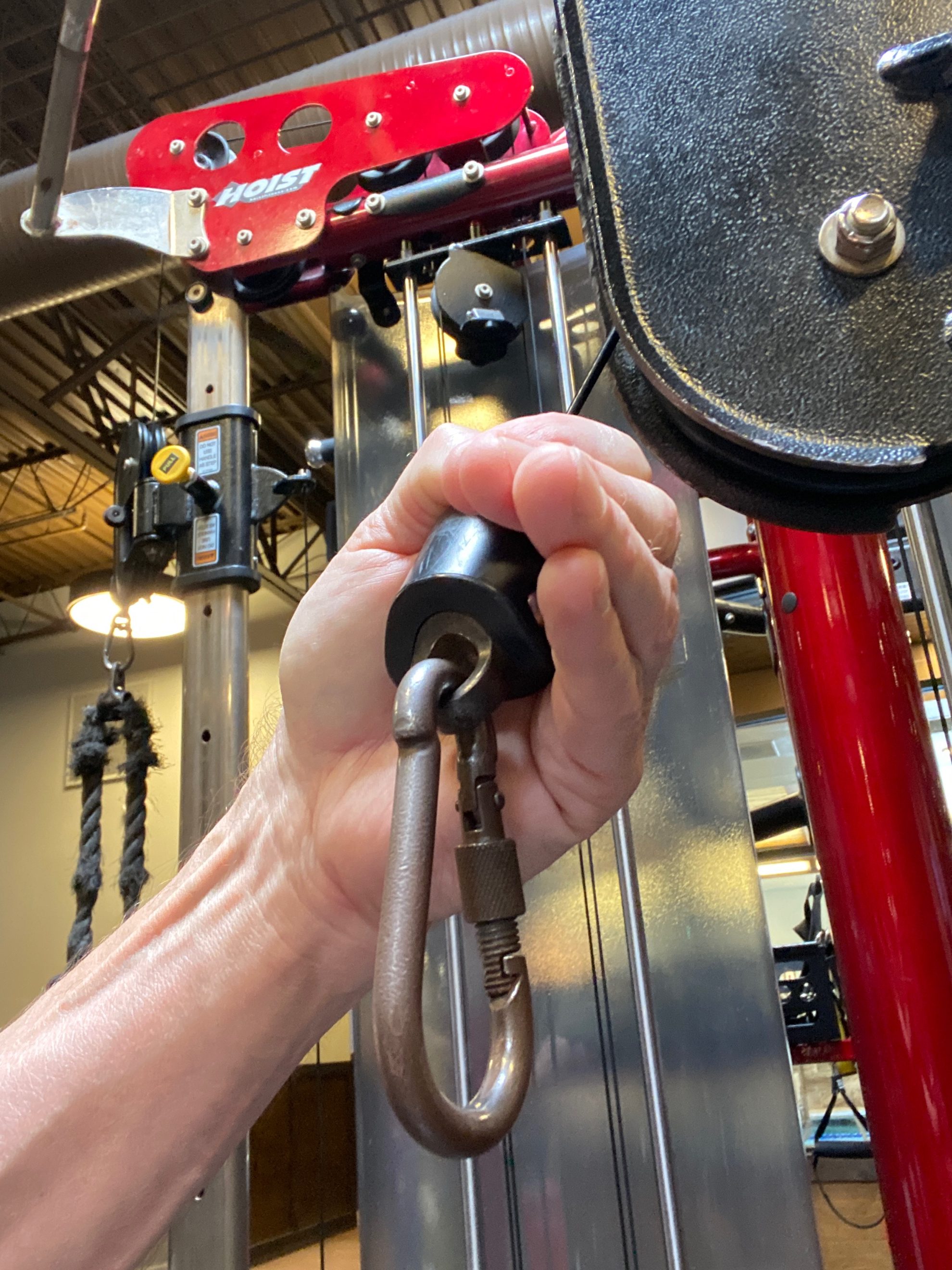
Don’t feel obligated to do them that way. There are some excellent options.
You can attach handles if you like.
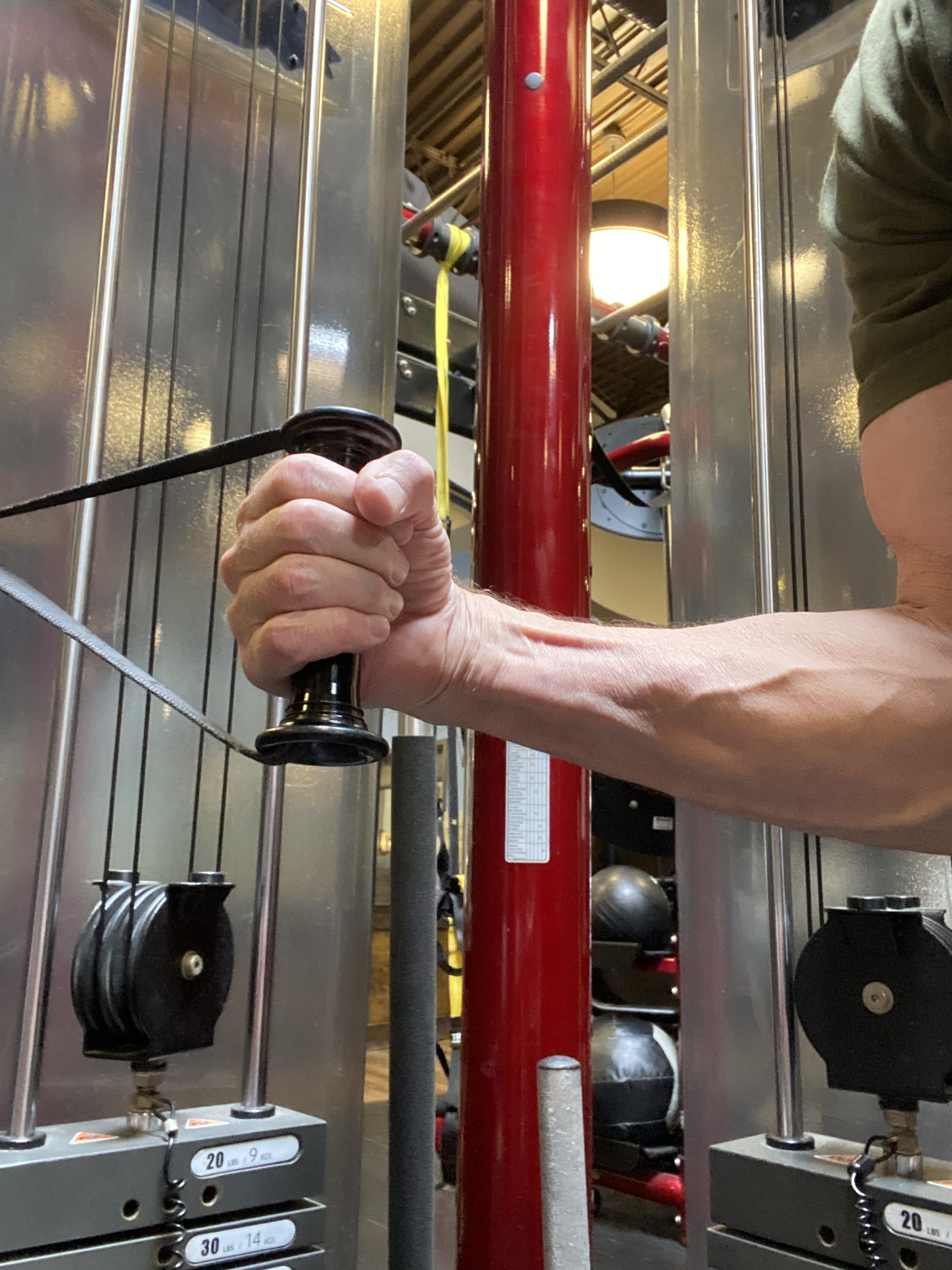
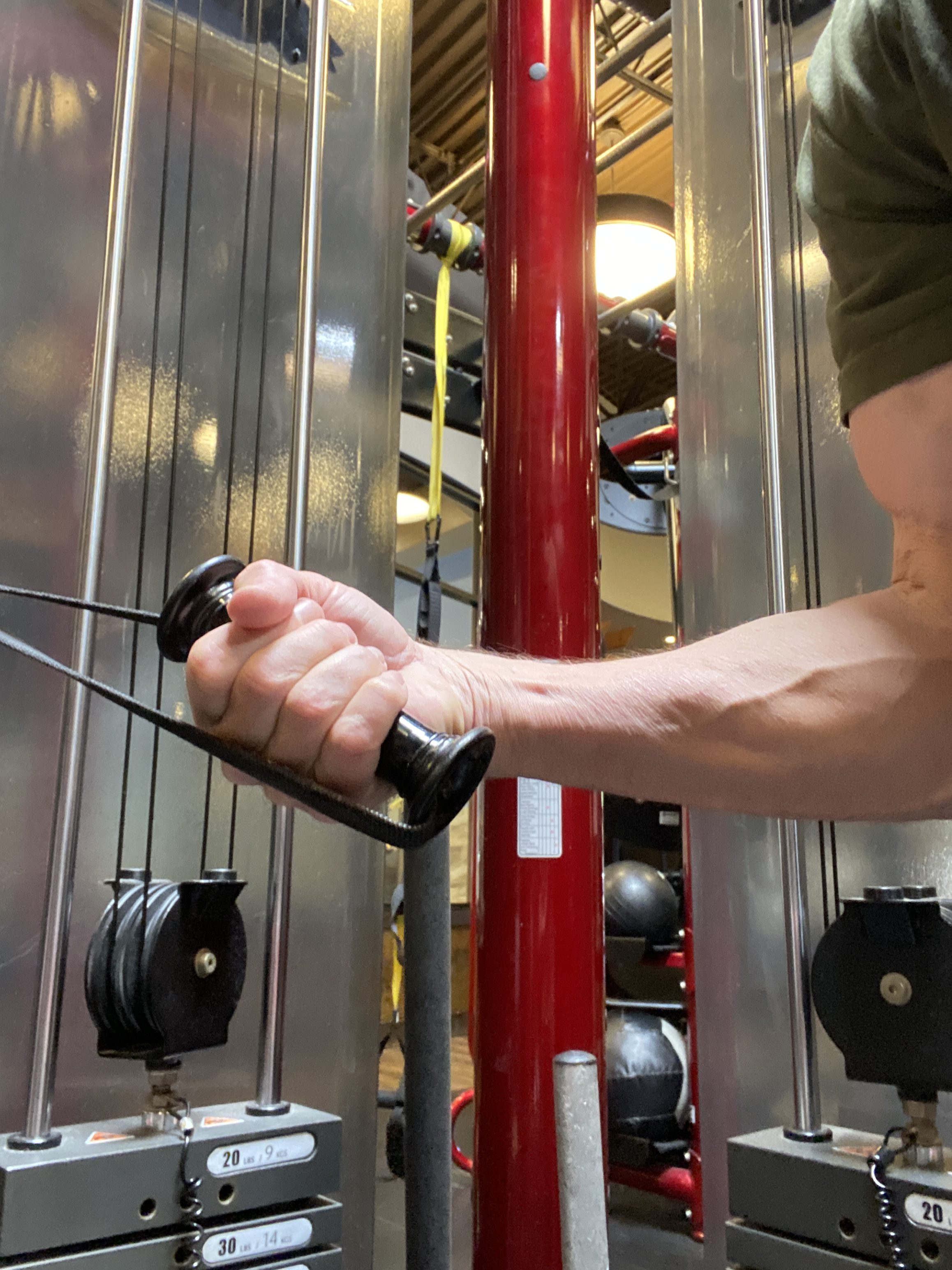
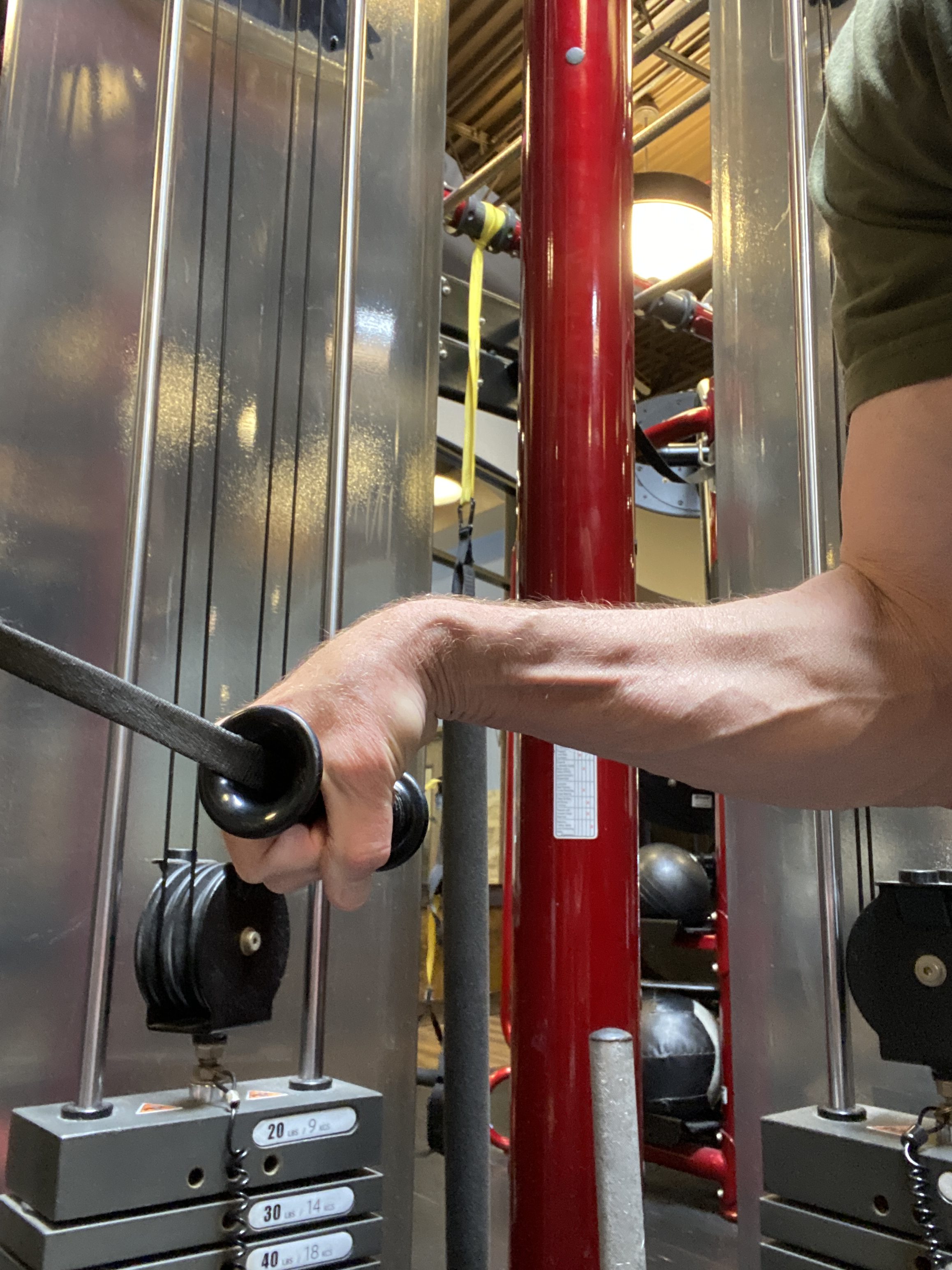
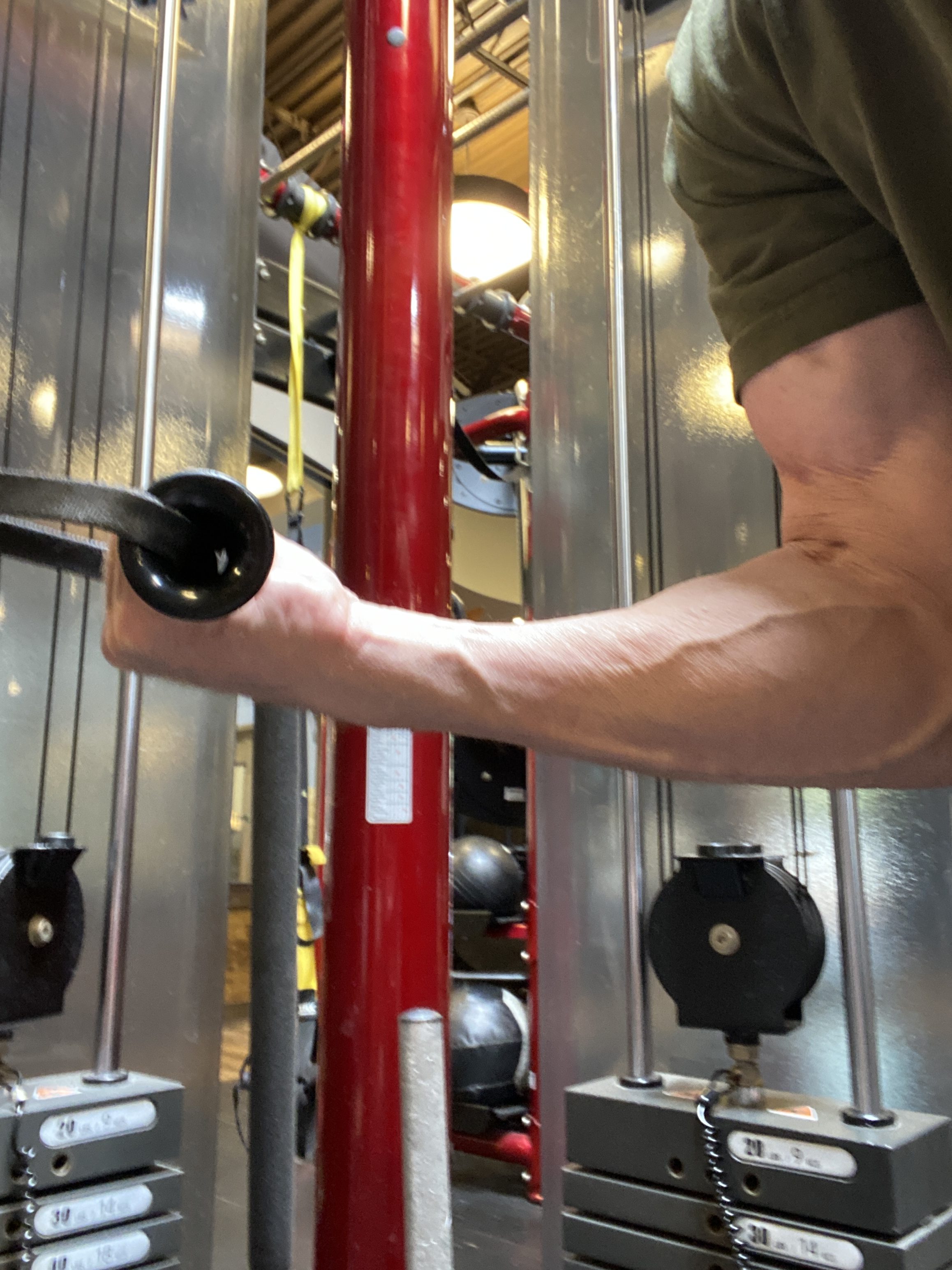
Handles with hollow tube grips and web straps offer the most options because the hollow handles let you position it along the strap for a neutral, pronated, or supinated grip…whatever is most comfortable.
To give the cable tricep kickback its props, we’ve had to throw a little shade on the dumbbell kickback. Dumbbell kickbacks are very ineffective in recruiting triceps muscle when compared to cable tricep kickback, as we’ve shown using exercise science.
We acknowledge that some awesome triceps have been chiseled by lifters who did dumbbell kickbacks. But they did a lot of other triceps work as well. Attributing their success to dumbbell kickbacks would be a stretch, particularly when we analyze the movements. It’s also fair to say that those same athletes would have probably preferred cable tricep kickback if all the facts had been clear.
Let’s put it this way: Winston Churchill was an excellent writer and used the postal service to send his masterpiece letters. It’s a fair bet that he would use email today.
Avoid these common mistakes when doing cable tricep kickbacks. These two rules of thumb will keep your form pure and maximize the kickback’s effect on your tris.
The only body part that should move is your forearm. That’s it. Keep the rest of your body still throughout the exercise to avoid common mistakes. All the mistakes are related to using other body parts to generate momentum to move the weight. Here they are:
Physiologically, the long head of the triceps participates in shoulder extension, meaning it participates in moving the upper arm backward.
Knowing this, you might then think that it would be beneficial to move the upper arm at the “top” of the kickback to work the triceps a bit more. That would be fine if this could be done under control and without creating momentum.
If you’re able to extend the upper arm forward slightly at the beginning of each rep and avoid the temptation of winding up to add momentum, then do it.
Keeping the upper arm and shoulder rigid and immobile sets the triceps up for success and maximal work. Shrugging at the top only detracts from the isolation, and can introduce momentum (which we’ve already described as unwanted).
Common mistake. “Hitching” is that subtle little hop between reps that puts momentum behind the kickback. The triceps is no longer isolated. Better to use a lighter weight and keep the entire body quiet and motionless, with the exception of the elbow and forearm. (See Rules above.)
Moving the wrist at the end of the kickback doesn’t do anything for the triceps. Some say it does.
Try this now: hold your left arm out to your side and make a fist like you’re gripping the cable. Put your right hand on the back of your left upper arm. Now, move your hand at the wrist in any direction you choose. Did your triceps do anything? No.
The triceps doesn’t control the wrist and the forearm muscles control hand movement because neither the wrist nor the hand is connected to the triceps.
No matter what grip or wrist-hand movement you add, the triceps will be unaffected. Comfort during the exercise is the only reason to do anything different with the hand or wrist.
It is a misconception that changing grip can isolate different heads of the triceps. This is because the triceps all converge into a single tendon, and it’s the tendon that pulls across the elbow and articulates the forearm.
You can demonstrate this yourself by turning your back partially to a mirror so that you can see the back of your arm.
With the back of your arm toward the mirror, simulate a one-arm pushdown. Now, change the direction your hand faces. Watch how the triceps reacts in the mirror as you do this, and you’ll see that the triceps moves in exactly the same way, no matter how you turn your hand.
You can do the same experiment without a mirror by simply placing your opposite side hand on your triceps and feeling the motion.
There are two tasty alternatives to the cable tricep kickback:
You’ve probably done this exercise before on a flat bench. A decline bench or adjustable sit-up board puts positions you to isolate the triceps a bit better than a flat bench, but both work fine.
The Single-Arm Standing Cable Extension is exactly the same exercise in every way other than the orientation of the torso.
Why bend at the waist and do a cable tricep kickback when you can stand up straight and do the same thing? That’s the beauty of a cable machine.
Look at the photos below. In the one on the left, the lifter standing. In the photo on the right, he’s bending at the waist, using traditional kickback form.
What’s the difference from a triceps point-of-view?
Nothing.
In these photos, we’ve added lines to accentuate the angle created by the upper arm and lower arm. As you can see, they are identical.
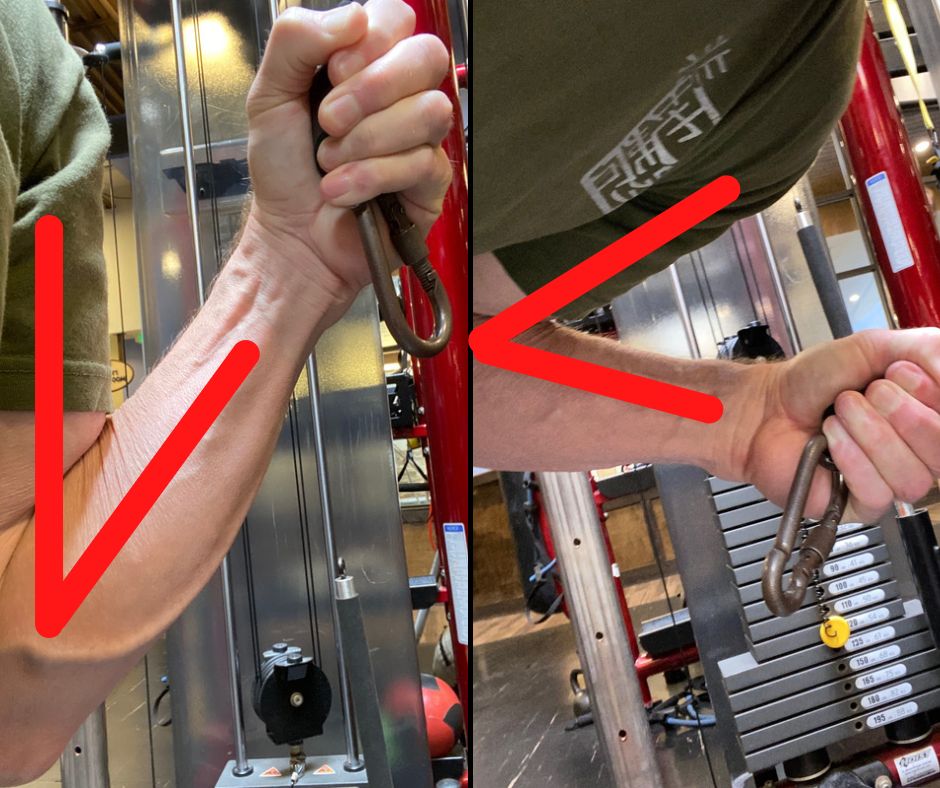
Your triceps has no idea where the pulley is located. It only senses resistance.
For the standing cable extension:
You may find the standing version more comfortable. Remember to keep the elbow at your side to avoid upper arm or shoulder movement.
Perhaps the only potential drawback to the standing version is the temptation to hitch the legs. Use a weight that allows you to do the exercise using the pristine form without the need to use other body parts to move it.
Start with high-rep sets. Use a very-high rep set or two for warm-up, then lower the reps and increase the weight until you wrap up with a challenging set of six or four. Mr. Universe Doug Brignole follows this method. Here’s what it looks like written out:
Although, you can play around with the 4th, 5th, and 6th sets and adjust up or down depending on how your muscles are feeling that day, and where you are in a training cycle.
Alternate kickbacks and hammer curls or palms-up dumbbell curls in order to take advantage of the reciprocal inhibition, described above.
You can do this as alternating sets, or as supersets.
Here’s an example (assuming you’re warmed up):
…and so forth.
You’ll be surprised at how much stronger each exercise becomes once you’ve finished a set using the opposing muscle. So, this is reciprocal inhibition at work.
This is as straightforward (no pun intended) as it gets.
Cable tricep kickbacks
However, there’s debate over how many sets are optimal for muscle growth. Eight-time Mr. Olympia said, “Stimulate, don’t annihilate.” Therefore, the key is getting muscle recruitment and not over-training.
We hope we’ve made a strong case for you to integrate the cable tricep kickback into your workout routine since they are an excellent unilateral triceps builder.
Recapping the reasons why the cable tricep kickback works so well:
The cable tricep kickback is so efficient at working the muscle, and such a terrific triceps isolator, it can become the only exercise you use to build an enviable set of upper arms.